Hiring a roofing company is one of those decisions that feels simple until you start comparing quotes and realizing how much can go wrong. Two contractors can give you two wildly different prices for what sounds like the same job, and the truth is, it often is not the same job. The difference is usually hidden in the details: licensing, insurance, scope, installation standards, and whether the company has a track record you can actually verify.
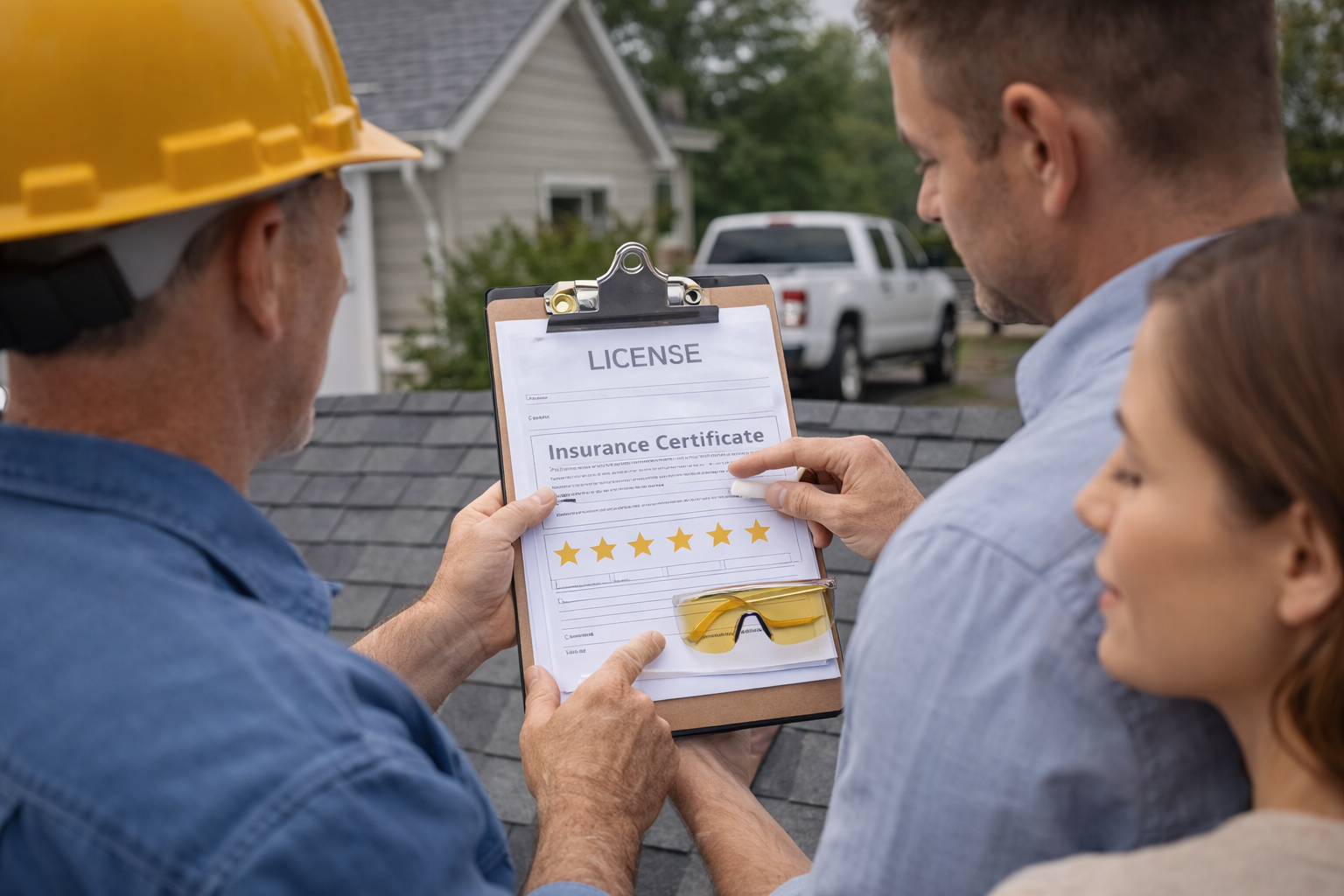
This checklist is designed to help you choose a roofing company confidently by focusing on three pillars that protect you most: licenses, insurance, and reviews. You will also get a few additional checks that matter just as much once you’ve confirmed the basics.
Use this checklist before you sign anything, before you hand over a deposit, and especially after a storm when “fast” can tempt homeowners into risky decisions.
Why this checklist matters
A roof is not just shingles. It is a system that keeps water out, manages heat and moisture, and protects the structure of your home. If the work is done poorly, the consequences are expensive:
- leaks that damage ceilings and insulation
- mold and moisture problems in attics
- rotted decking and framing
- voided manufacturer warranties
- disputes over what was “included”
- liability exposure if a worker is injured on your property
The goal of this checklist is to reduce your risk and make sure the company you hire is accountable, qualified, and transparent.
Part 1: Licensing checklist
1) Confirm the company is legally allowed to do roofing work
In many places, roofing contractors must hold a license. In some locations, requirements vary by job cost, by specialty, or by city and county. Your job is to confirm two things:
- Is a license required where you live for this project size?
- If yes, does the contractor hold the proper license and is it active?
A legitimate roofing company should not hesitate to share their licensing details. If they avoid the topic, get defensive, or ask you to “just trust them,” that is a warning sign.
What to ask for:
- the contractor’s license number (if required)
- the business name tied to the license
- the license classification (roofing or general contracting, depending on your area)
- confirmation that the license is active and in good standing
2) Make sure the license matches the company you’re paying
This is a common trap: a salesperson shows you a license, but it belongs to a different company, a related entity, or someone “they work with.” If the license is not tied to the legal business name on your contract and invoice, you may have fewer protections.
Quick verification rule:
The license holder name should match the name on the contract, proposal, and payment instructions.
3) Verify local registration requirements
Even when a state license is not required, many cities and counties require contractors to be registered or permitted. A trustworthy roofer in your area should be able to explain:
- what permits are required
- who pulls the permits
- whether your job triggers additional code requirements
If the contractor says permits are “never needed” or tries to talk you out of them, be cautious. Permits are not just paperwork; they ensure basic code compliance and create a paper trail for your property.
4) Confirm the company is a real business entity
Roofing is full of temporary operators after storms. You want a company that is established enough to be accountable if something goes wrong.
What to check:
- full legal business name
- business address (not just a P.O. Box)
- phone number and email that match their branding
- how long they have operated under that name
You do not need a massive company. You need a real one.
Part 2: Insurance checklist
Insurance is not optional. Roofing is one of the most dangerous home improvement trades, and accidents happen even with great crews. The two insurance policies that matter most are:
- General Liability Insurance
- Workers’ Compensation Insurance
5) General liability insurance is non-negotiable
General liability insurance protects you if the roofer causes damage to your property or someone else’s property. That includes:
- broken windows
- damaged siding or gutters
- interior water damage caused by improper weather protection
- landscaping damage caused by negligence
What to ask for:
- a copy of the Certificate of Insurance (COI)
- the policy effective dates
- coverage limits (often shown on the COI)
- the insurance carrier name
Best practice:
Ask your roofer to have their insurance agent send the COI directly to you. It reduces the chance you’re handed an outdated or altered document.
6) Workers’ compensation protects you from liability
If a worker is injured on your property and the company does not carry workers’ comp, you could be pulled into a claim, especially if the worker is misclassified as an independent contractor.
A contractor who says “my guys are subcontractors so I don’t need workers’ comp” is a red flag unless they can provide proper documentation showing that each subcontractor carries their own workers’ comp coverage.
What to ask:
- proof of workers’ compensation coverage
- confirmation that the roofing crew is covered
- if subcontractors are used, proof of coverage for the subs too
7) Beware of “exclusions” and “low limits”
Some policies exclude roofing operations or have low limits that do not match the risk. This is one reason it matters to receive the COI directly from the insurer and ask questions if something looks odd.
8) Confirm the company is insured in your state
Insurance can be location-specific. If a company is based out of state and entered your area after a storm, you should verify that their insurance is valid for work where you live.
9) Ask about warranty backing and what happens if there’s a problem
Insurance does not replace a warranty, but companies that operate responsibly tend to have both:
- workmanship warranty on labor
- manufacturer warranty on materials
A roofing company should clearly explain:
- what is covered
- for how long
- what voids coverage
- how claims are handled
If warranty language is vague, ask for it in writing.
Part 3: Reviews checklist
Reviews can be useful, but only if you evaluate them correctly. Roofing is an industry where fake reviews and review manipulation happen, especially after storms. Your goal is not to find a company with a perfect rating. Your goal is to find a company with a credible pattern of quality work, clean communication, and accountability.
10) Look for review consistency across platforms
A company that is truly established often has reviews in more than one place. If the contractor has dozens of glowing reviews on one platform but nothing anywhere else, be cautious.
11) Read the negative reviews first
A few negative reviews are normal. What matters is:
- what the negative reviews complain about
- how the company responded
- whether the same issue repeats
Examples of “normal” complaints:
- minor scheduling delays
- weather-related rescheduling
Examples of higher-risk complaints:
- unreturned calls after payment
- unresolved leaks
- warranty refusals
- surprise charges
- sloppy cleanup and property damage
12) Check review recency and volume
A company that suddenly received 40 five-star reviews in a single week after a storm might be boosting their profile. A more natural pattern is a steady flow of reviews over time.
13) Look for details that only real customers include
High-quality reviews usually mention specifics such as:
- the scope of work
- how the crew handled cleanup
- communication quality
- timeline accuracy
- warranty follow-through
Reviews that say only “Great job!” with no details are less meaningful.
14) Ask for recent local references you can verify
A solid roofing company should be able to provide references for work done recently in your area. A reference is most useful when it includes:
- similar roof type to yours
- similar scope (repair vs replacement)
- a homeowner willing to talk about the experience
If you can, ask a reference one simple question:
“Did the roof leak after install, and how did they handle follow-up?”
Part 4: Scope and contract checklist
Once licensing, insurance, and reviews check out, the next biggest risk is a vague scope of work. Many roofing disputes are not about bad intentions; they are about unclear expectations.
15) The proposal must be itemized and specific
A roofing estimate should not be a single number. It should list:
- roof material type and brand (when possible)
- shingle or metal system type
- underlayment type
- ice and water protection details and locations
- flashing scope (chimney, walls, valleys, vents)
- ventilation scope (ridge vents, intake, upgrades if needed)
- drip edge and edge metal scope
- tear-off details and number of layers
- disposal and cleanup process
- what happens if damaged decking is found
If any of these are missing, ask for a revised scope before you sign.
16) Confirm what is excluded
Good contracts include exclusions so you are not surprised later. Common exclusions might include:
- decking replacement beyond a certain amount
- structural repairs
- interior drywall repairs
- chimney masonry work
- gutter replacement
- skylight replacement (unless included)
Exclusions are not automatically bad; surprises are.
17) Change orders should be written
If the contractor discovers damaged decking or unexpected issues, you want a written change order with:
- the added scope
- the added cost
- your approval before work proceeds
If they say “we’ll just handle it and tell you later,” that is not acceptable.
Part 5: Workmanship checklist
18) They explain the “why,” not just the product
A quality roofer should be able to explain why ventilation matters, how flashing prevents leaks, and why certain materials fit your roof. If they only talk about “30-year shingles,” you may be dealing with a sales pitch, not a roofing plan.
19) They have a clear timeline and cleanup plan
You want to know the start date, expected duration, how they protect landscaping, how debris is handled, whether magnets are used for nails, and what happens if weather interrupts work.
20) They protect the home during tear-off
If the roof is opened, underlayment should be installed promptly and the home should not be left exposed when avoidable.
21) They manage crews responsibly
Ask whether they use employees or subcontractors and who is accountable on site. If subcontractors are used, you still want consistent standards and proof of coverage.
Part 6: Payment checklist
22) Avoid large upfront cash deposits
A reasonable deposit is normal, but a demand for a huge cash payment upfront is risky. A safer structure is deposit, progress payment, then final payment after completion and walkthrough.
23) Never pay in full before the job is completed
Paying in full removes leverage. Keep the final payment until the job is finished and verified.
24) Ask about lien releases
Suppliers or subcontractors can sometimes file a lien if they are not paid. Ask what documentation you’ll receive to confirm payments.
Part 7: Storm season checklist
25) Be wary of door-knocking pressure
If someone shows up uninvited and demands immediate action, slow down and verify everything.
26) Verify local presence
Ask where their office is, who handles warranties locally, and how long they’ve worked in your area.
27) Read assignment documents carefully
Some forms can transfer control of your insurance claim. If you are unsure, pause before signing.
Why homeowners hire The Roof Resource
If you like the checklist above but don’t want the hassle of running it on three different contractors, that’s exactly where The Roof Resource helps.
We make roofing easier by removing the confusing parts homeowners hate most: shopping bids, decoding scopes, and wondering where the markup is. Our process is built around speed, clarity, and accountability.
Here’s how we work:
- Fully transparent pricing with zero retail markup
You get an open-book proposal and materials list, with a flat service fee and no hidden markups on labor or materials. - Fast, accurate estimates without the in-home sales pitch
You receive a free estimate within 24 hours based on real measurements, using advanced satellite measurement tools, so you can get answers without scheduling a high-pressure appointment. - Simple scheduling and a streamlined path to installation
A third-party national inspection company performs an attic inspection, and then installation is typically scheduled within 7 to 10 days depending on weather and material availability. - Choice and clarity instead of guesswork
You choose from approved material brands and options, and everything is outlined clearly so you can make a decision without feeling rushed.
In short, The Roof Resource gives you the confidence of a rigorous contractor screening process, without forcing you to spend weeks managing it yourself.
The simplified master checklist
If you want the fastest version, use this:
Licenses
- Proper license if required
- License name matches contract name
- Permits pulled when needed
Insurance
- General liability COI provided
- Workers’ comp provided
- Coverage valid for your location
Reviews
- Reviews across platforms
- Negative review patterns make sense
- Recent local references available
Scope
- Itemized scope with materials and methods
- Clear exclusions
- Written change order process
Professionalism
- Timeline and cleanup plan
- Clear communication
- No pressure tactics
Payments
- Reasonable deposit
- No full payment upfront
- Documentation provided
Conclusion: make the decision easier, not harder
Choosing a roofing company should not require you to become a roofing expert. If you follow this checklist, you’ll avoid most of the expensive mistakes homeowners make, especially around licensing, insurance coverage, and misleading reviews.
And if you want to make it even easier, The Roof Resource is built to remove the hassle. Instead of spending days collecting bids and comparing vague scopes, you get clear options, fully transparent pricing, and a streamlined process that helps you move from quote to installation with far less stress.
More Articles

Questions to Ask a Roofer: 20 Must Ask Items Before Signing Today

How to Compare Roofing Quotes: Apples to Apples Price Guide Today

Drip Edge Installation: Why Code Requires It in Many Areas Today in East TN

Best Roof Sealants for Leaks: Which Products Actually Last Today